Hi there. I work for a university in IT. We’d like to create private discourse categories (which would map to courses), where only members of the course and the instructors would have access.
Wondering if anyone else is doing this currently and could share their experiences. Thanks!
Given the quality of the forums included in the LMSes I’ve had the misfortune to be exposed to over the years, Discourse would be an intergalactic leap forward in user experience.
We’ve got plenty of educational institutions amongst our hosted customer base, although I don’t see any obviously listed on our customers page. I’d be surprised if some of them weren’t using Discourse as a course discussion system. Hopefully one or more admins from those sites hang around here and can add their thoughts.
We have two approaches that both seem to work out:
For a mathematics preparatory course, we have one permanent Discourse instance that we re-use every year. This makes sense for us, because the course is organized by a team of volunteers, and there is both a large overlap between two consecutive years’ teams, and often a bit to discuss between courses. We archive and tag all topics before the preparations for a new course start. You can read a bit about my journey to do this here:
For other courses, we use one Discourse instance for each iteration. So far, we’ve been simply shutting them down in the end, but in the future, I want to use multisite so I can keep the old instances running without causing significant additional load.
We use a custom course management system that manages submissions, grades, exams and so on. This CMS has a built-in phpBB-based forum, but also supports Discourse SSO – so in the courses where we use Discourse, the “Forum” link in the CMS simply triggers an SSO login to the (login required) Discourse instance for this course. The Discourse instance has a site customization which adds a navigation bar on top, allowing you to get back to the CMS.
I’m sure one large Discourse instance with subcategories could work too, but we’ve made a really good experience with our one-instance-per-course approach.
Hi, Jeff. I was once an instructional technology professor in colleges of education. In my last gig, I taught my classes with Discourse (which is part of why I now make my living with Discourse).
I organized assignments (or quests) in read-only categories and instructed students to reply-as-linked-topic (now on the link icon below a post) and put their post into the category for their class with a particular tag for that assignment. This made it easy for students to comment on each others work and for me to see whether students had done the work. I would their topic if they had completed the assignment, and wrote a script that would see that students had done the assignment and gave different grades if I had liked it and if other students had. It’s probably not helpful, but you can have it.
Having the assignments in their own categories made it easy to re-run a course and to use an assignment in multiple courses. The other cool thing is that when it was obvious that an assignment was badly worded or otherwise needed changing, I could change it immediately, making life better for the slackers who did the work late, and meaning that all those changes to assignments that I might otherwise have intended to do before next semester were, in fact, done.
You can see a syllabus for the last class I taught and this one too. This also worked really well, since the assignments were separate from the course, there wasn’t the copy-the-old-course-to-the-new-one at the start of each semester. All that was needed was to copy the syllabus and change the dates on it.
My courses were all (and remained for a time) public. Changing that is just a matter of changing the permissions on the categories, though. I think that I just put a link to the course in the school’s LMS to get people to sign up. You could use groups to invite students to the course and control access.
Still getting our feet wet with the tool, but leaning toward making each course a private category (or maybe sub-category?), with permissions granted to a group that contains the students, instructors, and TAs for that course.
We could be running hundreds of courses each semester, which means we’d end up with loads of (private) categories. That could eventually be a problem for us, as it looks like there could be issues with having much more than 1000 categories (?), based on what I’m seeing in this topic:
So perhaps we’d need to archive these off at some point…but we’re not going to hit that limit overnight.
We’d definitely need to bump up the default character limit for group names to accommodate unique names for courses/sections, and it looks like this is doable. Hurray!
@pfaffman thanks for sending along your examples! We’ll give those a closer look and let you know what questions come up. And thanks, @fefrei for sharing how you’re approaching this at your institution. Plenty to think about!
Olá, Jay, tentei acessar esses links, mas infelizmente recebi a mensagem “Esta Conexão Não É Privada”. Ainda é possível ver como você organizou seu curso? Estou explorando se posso hospedar o currículo do curso no Discourse, de forma semelhante a plataformas como Thinkific.
Sim, deixei aquele site morrer e agora acho que existem maneiras melhores de fazer o que eu fiz na época.
Ainda assim, acho que ter conjuntos de tópicos com o que você chama de “tarefas” em uma categoria somente leitura, para que as pessoas criem um tópico com sua “resposta” em alguma categoria com uma tag indicando a tarefa, é viável, talvez com um tema para melhorar a experiência do usuário.
Também existem alguns truques para criar links que iniciam um novo tópico que poderiam ajudar, por exemplo.
Minha maior dificuldade é que não consigo ordenar os tópicos em uma categoria. É muito satisfatório percorrer um curso em ordem e marcar visualmente cada elemento do curso como concluído. Estou me perguntando se é possível fazer isso. Também estou pensando em um componente de tema que possa mostrar que você gostou de um tópico na página de lista de tópicos, pois essa pode ser a maneira mais fácil de usar recursos existentes para ter essa satisfação rápida de ter concluído um tópico. Ou, seria possível adicionar uma barra lateral? Adoraria ouvir ideias.
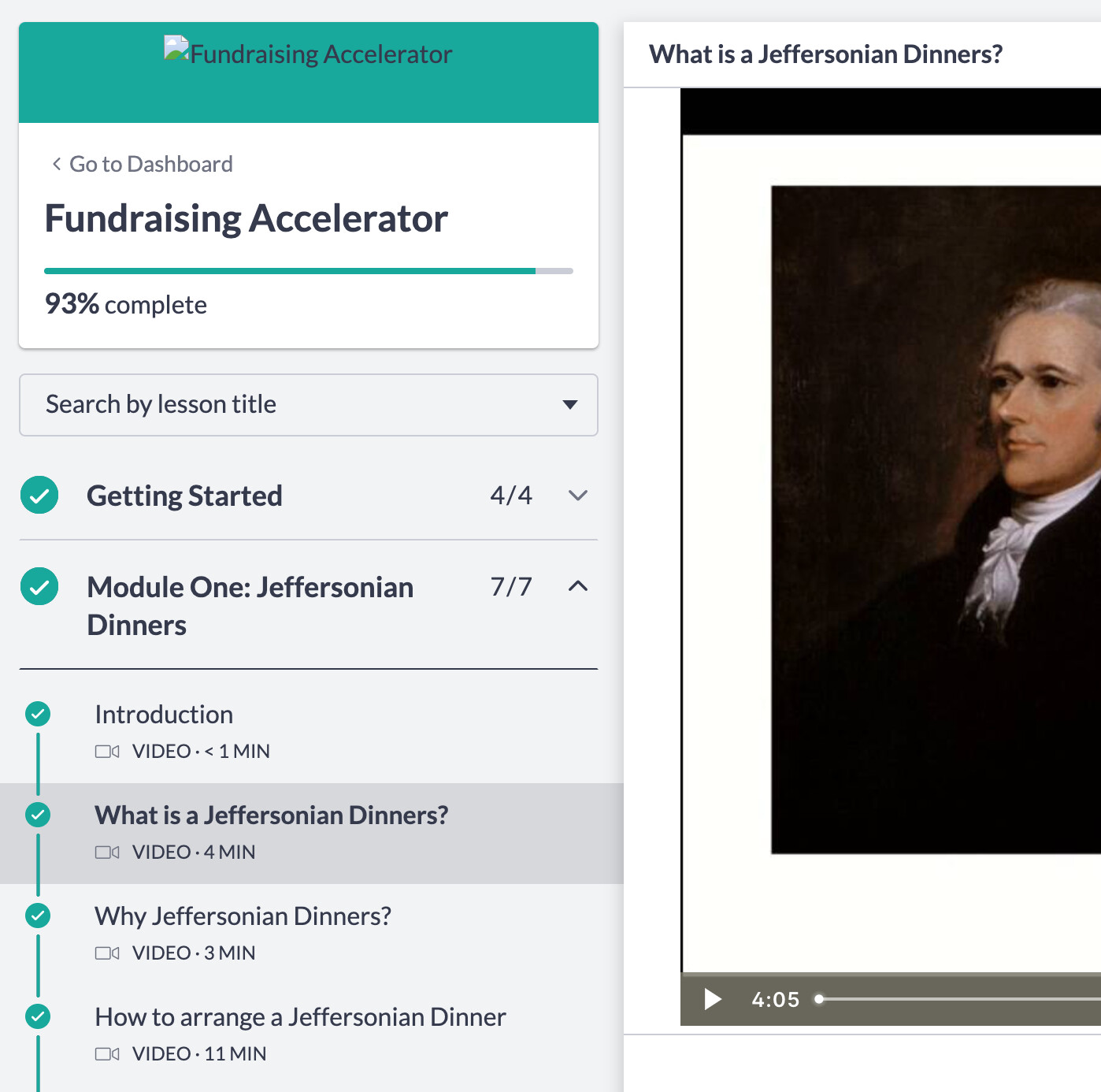
Título Getting Started, marca de seleção verde à esquerda, indicador 4/4 à direita, seta de expansão
Título Module One: Jeffersonian Dinners, marca de seleção verde à esquerda, indicador 7/7 à direita, seta de ocultar
Aninhado abaixo do título Module One: Jeffersonian Dinners e em fonte menor
Título Introduction
Título What is a Jeffersonian Dinners?, destacado para indicar que este é o tópico atual
Why Jeffersonian Dinners?
How to arrange a Jeffersonian Dinner
Coluna da direita
What is a Jeffersonian Dinner? Contém uma lição em vídeo mostrando um retrato de Thomas Jefferson
Há uma discussão aqui sobre como manter os tópicos em ordem, mas parece apenas uma solução alternativa menos do que ideal.
Eu também pensei nisso. O que acabei fazendo foi usar um tópico como a página inicial do curso, em vez de uma categoria. Dessa forma, posso usar uma tabela de conteúdos para estruturá-lo como preferir.
Sim, eu também estava pensando nisso. Você fez algo especial para manter esse tópico fácil de encontrar/visível? Alguma ideia? Minhas ideias atuais são:
Ideia #1: Estruturar o tópico inicial do curso como uma lista de verificação. Use o Reply Template para que os alunos possam criar suas próprias listas de verificação. Ensine-os a marcar o tópico como favorito ou a atribuí-lo a si mesmos para encontrá-lo mais facilmente. Dessa forma, o tópico pessoal do curso também pode servir como um diário de aprendizagem, onde eles podem responder com reflexões, etc.
Ideia #2: Adicionar um link para o tópico inicial do curso na descrição da categoria e usar um dos muitos componentes de tema de banner de categoria, como Pavilion, para facilitar o clique no tópico inicial do curso. Isso não inclui o componente de lista de verificação, mas tem a vantagem de facilitar a atualização do início do curso e garantir que a alteração seja refletida para todos. Esse tópico também pode servir como um thread de anúncios.
Ideia #3: Criar um tópico inicial do curso e, em seguida, usar um componente de barra lateral como Topic List Sidebars ou desenvolver algo por meio de Layouts Plugin. Mas e se alguém estiver acessando o curso no celular? Nenhum desses componentes de barra lateral parece facilitar a visualização em dispositivos móveis.
Isso está me ajudando a refletir sobre as funções que os cursos poderiam precisar:
Gosto da ideia de deixar a categoria somente para leitura, mas gostaria de ver primeiro como as pessoas interagem com os cursos, já que eles são públicos e de autoaprendizagem.
O que fiz foi usar um tópico como um plano de curso, conforme sugerido. Como em meu curso os alunos seguiam o mesmo cronograma, eu compactava ou expandia o conteúdo para que as informações da semana atual fossem mais fáceis de encontrar.
Também usei distintivos personalizados para acompanhar o que eles haviam feito. Cada tarefa (ou “desafio”, na minha terminologia do curso) tinha uma tag associada. Assim, quando eles postavam com a tag (e, creio eu, eu “curtia” o tópico), eles recebiam o distintivo, e eu podia usá-lo para rastrear quais tarefas haviam sido concluídas. Eu tinha um script que localizava o distintivo e atualizava uma célula em uma planilha, que eu podia então fazer upload diretamente na planilha de notas do LMS.
Bem, ‘automatizado’ em certo sentido. Acho que fiz algo como baixar um arquivo do LMS, depois chamar um script que verificava se o emblema (ou tópico?) estava lá e registrava um ‘crédito total’ se a pessoa tivesse concluído a tarefa, e eu podia então fazer o upload desse arquivo de volta para o LMS. Não era um sistema que eu esperaria que qualquer outra pessoa usasse, pelo menos não na forma como estava. Mas isso foi há muito tempo, e tanto a API quanto minhas habilidades são bem diferentes hoje.
Ah, mas a parte dos emblemas foi automatizada. Não foi difícil escrever o SQL para conceder os emblemas (você precisaria estar em uma instalação auto-hospedada ou em um plano que permita criar SQL personalizado para emblemas). Mas a interface de automação pode ser outra forma de acessar tudo isso, talvez.
Alguém encontrou uma maneira de usar os Comentários do Discourse para as Aulas do Thinkific? Estamos migrando atualmente para o Thinkific e nos perguntamos como conectar aulas a tópicos, assim como o WP Discourse faz.

 their topic if they had completed the assignment, and wrote a script that would see that students had done the assignment and gave different grades if I had liked it and if other students had. It’s probably not helpful, but