Hi there. I work for a university in IT. We’d like to create private discourse categories (which would map to courses), where only members of the course and the instructors would have access.
Wondering if anyone else is doing this currently and could share their experiences. Thanks!
Given the quality of the forums included in the LMSes I’ve had the misfortune to be exposed to over the years, Discourse would be an intergalactic leap forward in user experience.
We’ve got plenty of educational institutions amongst our hosted customer base, although I don’t see any obviously listed on our customers page. I’d be surprised if some of them weren’t using Discourse as a course discussion system. Hopefully one or more admins from those sites hang around here and can add their thoughts.
We have two approaches that both seem to work out:
For a mathematics preparatory course, we have one permanent Discourse instance that we re-use every year. This makes sense for us, because the course is organized by a team of volunteers, and there is both a large overlap between two consecutive years’ teams, and often a bit to discuss between courses. We archive and tag all topics before the preparations for a new course start. You can read a bit about my journey to do this here:
For other courses, we use one Discourse instance for each iteration. So far, we’ve been simply shutting them down in the end, but in the future, I want to use multisite so I can keep the old instances running without causing significant additional load.
We use a custom course management system that manages submissions, grades, exams and so on. This CMS has a built-in phpBB-based forum, but also supports Discourse SSO – so in the courses where we use Discourse, the “Forum” link in the CMS simply triggers an SSO login to the (login required) Discourse instance for this course. The Discourse instance has a site customization which adds a navigation bar on top, allowing you to get back to the CMS.
I’m sure one large Discourse instance with subcategories could work too, but we’ve made a really good experience with our one-instance-per-course approach.
Hi, Jeff. I was once an instructional technology professor in colleges of education. In my last gig, I taught my classes with Discourse (which is part of why I now make my living with Discourse).
I organized assignments (or quests) in read-only categories and instructed students to reply-as-linked-topic (now on the link icon below a post) and put their post into the category for their class with a particular tag for that assignment. This made it easy for students to comment on each others work and for me to see whether students had done the work. I would their topic if they had completed the assignment, and wrote a script that would see that students had done the assignment and gave different grades if I had liked it and if other students had. It’s probably not helpful, but you can have it.
Having the assignments in their own categories made it easy to re-run a course and to use an assignment in multiple courses. The other cool thing is that when it was obvious that an assignment was badly worded or otherwise needed changing, I could change it immediately, making life better for the slackers who did the work late, and meaning that all those changes to assignments that I might otherwise have intended to do before next semester were, in fact, done.
You can see a syllabus for the last class I taught and this one too. This also worked really well, since the assignments were separate from the course, there wasn’t the copy-the-old-course-to-the-new-one at the start of each semester. All that was needed was to copy the syllabus and change the dates on it.
My courses were all (and remained for a time) public. Changing that is just a matter of changing the permissions on the categories, though. I think that I just put a link to the course in the school’s LMS to get people to sign up. You could use groups to invite students to the course and control access.
Still getting our feet wet with the tool, but leaning toward making each course a private category (or maybe sub-category?), with permissions granted to a group that contains the students, instructors, and TAs for that course.
We could be running hundreds of courses each semester, which means we’d end up with loads of (private) categories. That could eventually be a problem for us, as it looks like there could be issues with having much more than 1000 categories (?), based on what I’m seeing in this topic:
So perhaps we’d need to archive these off at some point…but we’re not going to hit that limit overnight.
We’d definitely need to bump up the default character limit for group names to accommodate unique names for courses/sections, and it looks like this is doable. Hurray!
@pfaffman thanks for sending along your examples! We’ll give those a closer look and let you know what questions come up. And thanks, @fefrei for sharing how you’re approaching this at your institution. Plenty to think about!
Hola Jay, intenté ver estos enlaces pero, lamentablemente, recibí un mensaje que dice: “Esta conexión no es privada”. ¿Sigue siendo posible ver cómo organizaste tu curso? Estoy explorando la posibilidad de alojar el plan de estudios del curso en Discourse, similar a plataformas como Thinkific.
Sí, dejé morir ese sitio y ahora creo que hay mejores formas de hacer lo que hice entonces.
Aun así, pienso que tener conjuntos de temas con lo que llamas “tareas” en una categoría de solo lectura, para que la gente cree un tema con su “respuesta” en alguna categoría con una etiqueta que indique la tarea, es viable. Quizás con un tema que mejore la experiencia de usuario.
También existen algunos trucos para crear enlaces que inicien un nuevo tema, lo cual podría ayudar, por ejemplo.
Mi mayor dificultad es que no puedo ordenar los temas dentro de una categoría. Es muy satisfactorio recorrer un curso en orden y marcar visualmente cada elemento del mismo. Me pregunto si es posible hacerlo. También estoy pensando en un componente de tema que muestre que te gustó un tema en la página de lista de temas, ya que esa podría ser la forma más sencilla de aprovechar las funciones existentes para tener esa satisfacción instantánea de haber terminado un tema. O, ¿sería posible añadir una barra lateral? Me encantaría recibir ideas.
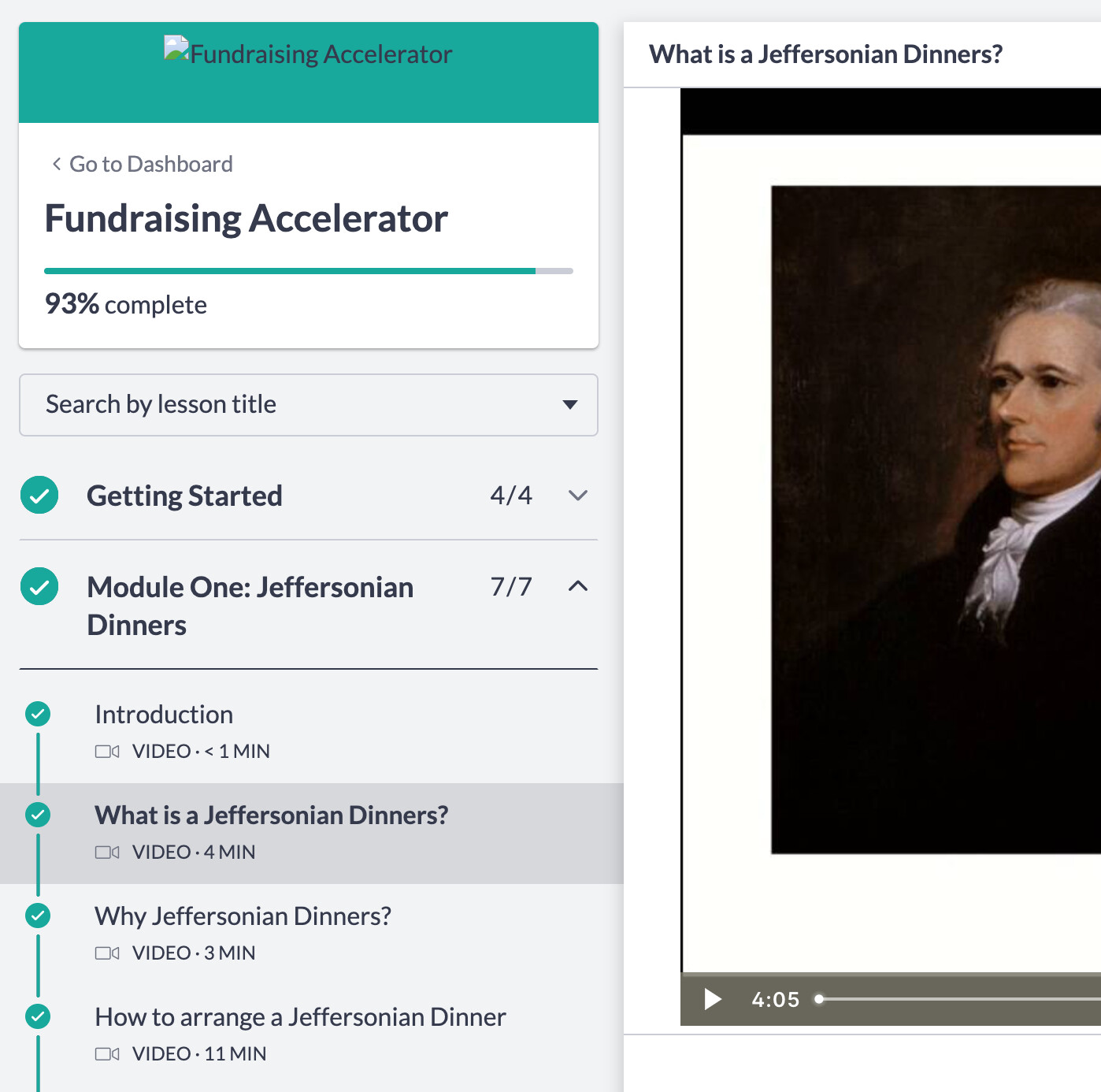
Aquí hay una captura de pantalla de la experiencia de usuario (UX) de Thinkific.
Caja de búsqueda para buscar por título de lección
Título “Getting Started”, marca de verificación verde a la izquierda, indicador 4/4 a la derecha, flecha de expansión
Título “Module One: Jeffersonian Dinners”, marca de verificación verde a la izquierda, indicador 7/7 a la derecha, flecha de ocultar
Anidado debajo del título “Module One: Jeffersonian Dinners” y en fuente más pequeña
Título “Introduction”
Título “What is a Jeffersonian Dinners?”, resaltado para indicar que ese es el tema en el que estamos
“Why Jeffersonian Dinners?”
“How to arrange a Jeffersonian Dinner”
Columna derecha
“What is a Jeffersonian Dinner?”: Contiene una lección en video que muestra un retrato de Thomas Jefferson
Hay una discusión aquí sobre cómo mantener los temas en orden, pero parece ser una solución de compromiso menos que ideal.
También pensé en esto. Lo que finalmente hice fue usar un tema como página de inicio del curso en lugar de una categoría, de modo que pueda usar una tabla de contenidos para estructurarlo como prefiera.
Sí, también estaba pensando en esto. ¿Hiciste algo especial para mantener ese tema único fácil de encontrar/visible? ¿Alguna idea? Mis ideas actuales son:
Idea #1: Estructurar el tema de inicio del curso como una lista de verificación. Usa el componente de plantilla de respuesta de Discourse Reply Template para que los estudiantes puedan crear su propia lista de verificación. Enséñales a marcar como favorito o asignar ese tema a sí mismos para que puedan encontrarlo más fácilmente. De esta manera, su tema personal del curso también puede servir como un diario de aprendizaje donde responden con reflexiones, etc.
Idea #2: Agregar un enlace al tema de inicio del curso en la descripción de la categoría y usar uno de los muchos componentes de tema de banners de categoría, como Pavilion, para que sea fácil hacer clic en el tema de inicio del curso. Esto carece del componente de lista de verificación, pero tiene la ventaja de facilitar la actualización del inicio del curso y que se refleje para todos. Este tema también puede servir como un hilo de anuncios.
Idea #3: Crear un tema de inicio del curso y luego usar un componente de barra lateral como Topic List Sidebars o codificar algo mediante Layouts Plugin, pero ¿qué pasa si alguien accede al curso desde un dispositivo móvil? Ninguno de estos componentes de barra lateral parece facilitar su visualización en móviles.
Esto me está ayudando a reflexionar sobre las funciones que creo que los cursos podrían necesitar.
Me gusta la idea de dejar la categoría en modo solo lectura, pero primero me gustaría ver cómo interactúa la gente con los cursos, ya que son públicos y de aprendizaje autodirigido.
Lo que hice fue utilizar un tema como temario, tal como se sugirió. Dado que en mi curso los estudiantes seguían el mismo calendario, comprimía o expandía el contenido para que la información de la semana actual fuera más fácil de encontrar.
También utilicé insignias personalizadas para rastrear lo que habían completado. Cada tarea (o “desafío”, según la terminología de mi curso) tenía una etiqueta asociada, de modo que cuando publicaban con dicha etiqueta (y, creo que, yo “daba me gusta” al tema), recibían la insignia. Esto me permitía rastrear qué tareas habían realizado. Contaba con un script que localizaba la insignia y actualizaba una celda en una hoja de cálculo, la cual luego podía subir directamente al libro de calificaciones del LMS.
Bueno, en cierto sentido “automatizado”. Creo que hice algo así como descargar un archivo del LMS, luego ejecutar un script que verificaba si el distintivo (¿o el tema?) estaba presente y registraba un “crédito completo” si lo habían completado, y luego podía subir ese archivo de nuevo al LMS. No era un sistema que esperara que alguien más usara, al menos en su estado original. Pero eso fue hace mucho tiempo y tanto la API como mis habilidades son bastante diferentes ahora.
Ah, pero la parte de los distintivos sí estaba automatizada. No fue demasiado difícil escribir el SQL para otorgar los distintivos (necesitarías estar autoalojado o en un plan que permita crear SQL personalizado para distintivos). Sin embargo, la interfaz de automatización podría ser otra forma de acceder a todo eso, quizás.
¿Alguien ha encontrado una forma de usar los comentarios de Discourse para las lecciones de Thinkific? Actualmente estamos migrando a Thinkific y nos preguntamos cómo conectar las lecciones con los temas, al igual que lo hace WP Discourse.

 their topic if they had completed the assignment, and wrote a script that would see that students had done the assignment and gave different grades if I had liked it and if other students had. It’s probably not helpful, but